3/4 cup dashi (Japanese soup stock) (use standard Awase Dashi, dashi packet or powder, or Vegan Dashi)
3 Tbsp gluten-free soy sauce
3 Tbsp mirin
For Serving
2 inches daikon radish
Instructions
Before You Start: I highly encourage you to weigh your ingredients using a kitchen scale for this recipe. For weights, click the Metric button above. If you‘re using a cup measure, please follow the “fluff and sprinkle“ method: Fluff your flour with a spoon, sprinkle it into your measuring cup, and level it off. Otherwise, you may scoop more than you need. Now, gather all the ingredients.
To Make the Dipping Sauce
In a small saucepan, add 3 Tbsp mirin. Bring it to boil over medium-high heat to let the alcohol evaporate.
Once boiling, add 3/4 cup dashi (Japanese soup stock) and 3 Tbsp gluten-free soy sauce and bring it to a boil. When it boils, turn off the heat and set aside.
To Prepare the Ingredients
Use a spoon to scoop the seeds from 1/8 kabocha squash. Without peeling the skin, cut the kabocha in half widthwise, then cut each half into ⅛-inch (3-mm) slices.
Cut 1 Japanese sweet potato (Satsumaimo) crosswise into 1/8-inch (3-mm) slices. Soak in water for 10 minutes to remove the starch.
After soaking for 10 minutes, pat dry the sweet potato with a paper towel to remove the moisture.
Make a couple of small slits on the skin of 8 okra. This will prevent the okra from exploding while deep-frying. Also, trim the ends of 8 French green beans (haricots verts). Keep the eggplant uncut for now.
To Prepare the Shrimp
Now, peel and devein 8 large and jumbo shrimp. For detailed, step-by-step instructions, see my post on How to Prepare Shrimp for Shrimp Tempura. For tempura, we remove the last segment of shell but keep the tail tip on. Using a knife, cut along the outer edge of the shrimp’s back.
If you see the vein, remove and discard it.
Optionally, you can soak the shrimp in 1–2 Tbsp sake to remove the unwanted odor.
Lay the shrimp on its side and cut the tip of the tail diagonally (see the left image). This will create a V shape when you open the tail (see the right image). Remove any moisture trapped in the tail by scraping it with the edge of the knife. This will prevent oil splatter during frying.
Make a couple of slits on the underside. Hold the shrimp with both hands and bend it backwards (belly up) until you hear a popping sound in each segment. Straighten the shrimp as much as possible.
To Make the Batter
In a medium bowl set on a kitchen scale, add 1 large egg (50 g each w/o shell). Then, pour enough water so the egg-and-water mixture weighs 200 grams. If you don‘t have a scale, add 1 egg to a 1-cup measuring cup, whisk the egg, and add water until you have ¾ cup (180–200 ml).
Mix well, then add 1/2 cup rice flour. Whisk until you see no more lumps of flour. Keep it in the refrigerator until you’re ready to deep-fry.
To Deep-Fry the Tempura
Bring 4 cups (960 ml) vegetable oil to 340ºF (170ºC) and check the oil temperature with an instant-read thermometer. To check with wooden chopsticks, dip them in the oil; when small bubbles form around the tips, the oil is ready. We’ll start deep-frying the hard, dense ingredients first because they will take longer to cook. Dry all the ingredients well with a paper towel so that moisture won’t dilute the batter. Every time you are ready to dip the ingredients, vigorously whisk the tempura batter first since the rice flour tends to separate from the liquid and settle to the bottom of the bowl. Plus, a bubbly tempura batter will help achieve a crispy, light shell around the vegetables and shrimp.
Coat the sweet potato slices with batter and deep-fry at 340ºF (170ºC) for 3 minutes. Do not overcrowd the surface of the oil. Keep the ingredients in a single layer, without overlapping. I put 4 pieces of sweet potato at a time in my deep fryer.
Once they are deep-fried, shake off the excess oil and transfer to a wire rack (or a plate lined with a paper towel). Continue with the rest of the sweet potatoes. Before moving on to the next ingredient or batch, ALWAYS remove the crumbs in the oil with a fine-mesh skimmer. Otherwise, the crumbs will burn and attach to your tempura. The burnt crumbs will also make the oil darker, which leaves a bad flavor.
Next up, kabocha. Whisk the tempura batter vigorously, coat the kabocha slices with the batter, and deep-fry at 340ºF (170ºC) for 3 minutes. Again, fry in batches and do not crowd the pot.
Deep-fry the okra and green beans next. Whisk the batter, coat the okra/green beans, and deep-fry at 340ºF (170ºC) for 2 minutes.
Keep the oil at the desired temperature while you prepare the eggplants. Quickly, but carefully, cut 2 Japanese or Chinese eggplants in half lengthwise. If the eggplant is long, cut each half into 2 equal size pieces.
Whisk the batter, coat the eggplant, and deep-fry at 340ºF (170ºC) for 2 minutes.
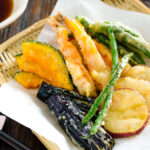
We use clean oil for the vegetables first, then we finish deep-frying with the shrimp since seafood has more flavor and you don’t want the vegetables to have a shrimp flavor. Whisk the batter, coat the shrimp, and deep-fry at 340ºF (170ºC) for 2 minutes.
Leave a Reply